Clinical Protocols for Severe Andes Virus Face ECMO and Fluid Constraints Off Praia
Critical care specialists responding to suspected Andes hantavirus cases off Cape Verde highlight the fine line between pulmonary edema and circulatory collapse as ECMO capacity remains tight.
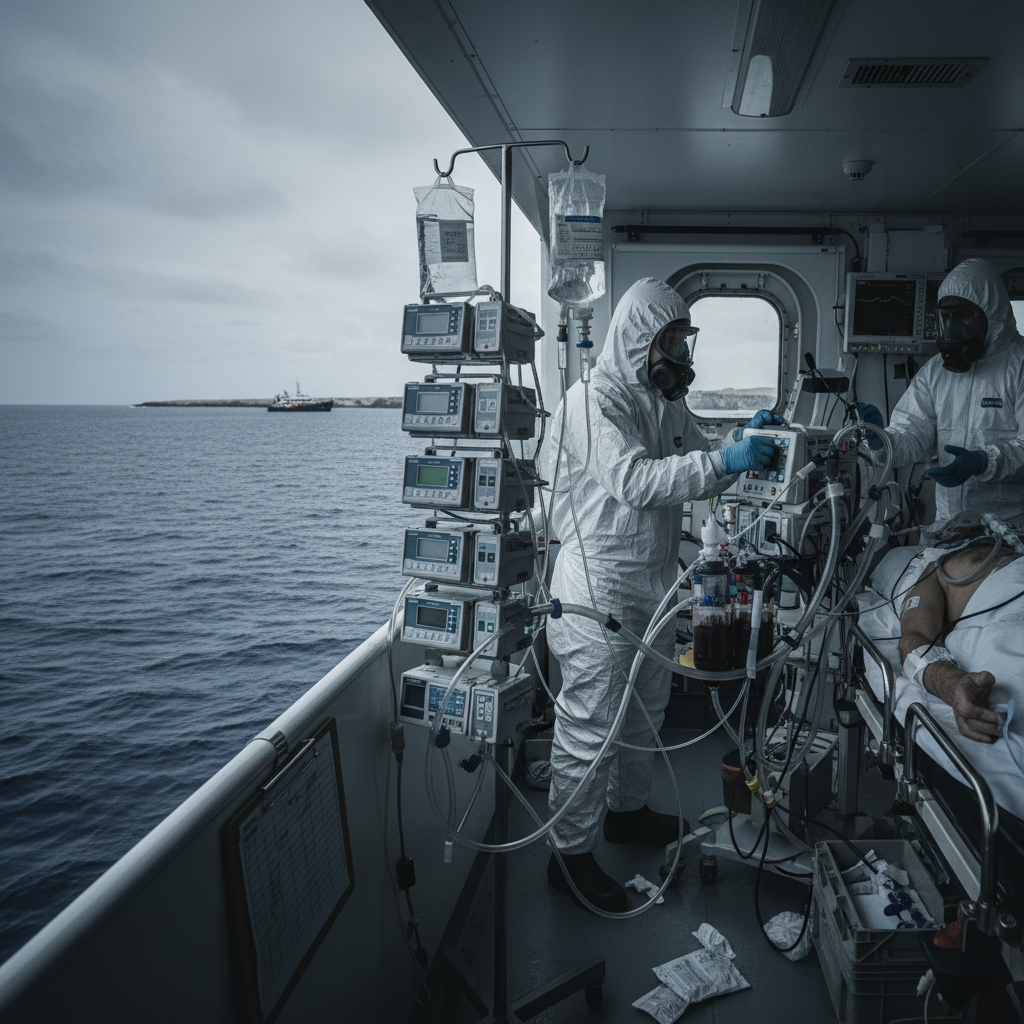
The Precipitous Shift to Cardiopulmonary Shock
Clinical management of severe Andes virus infection—the causative agent of Andes hantavirus cardiopulmonary syndrome (HCPS)—remains among the most unforgiving challenges in acute intensive care medicine. As international medical teams assist authorities in Cape Verde with medical responses linked to the chartered vessel MV Hondius, anchored off the capital of Praia, critical care teams are deploying strict supportive care protocols designed to mitigate rapid physiological collapse. Unlike many viral hemorrhagic fevers characterized by multi-organ hemorrhage, HCPS driven by Andes virus presents a predominantly cardiopulmonary crisis. According to clinical guidance from the U.S. Centers for Disease Control and Prevention (US CDC) and the Pan American Health Organization (PAHO), the hallmark of the disease is a sudden, immune-mediated permeability leak in the pulmonary microvasculature. Following a non-specific febrile prodrome lasting several days, patients can transition within a matter of hours into fulminant respiratory distress, severe hypoxemia, and profound cardiogenic shock. Critical care physicians tracking the condition note that myocardial depression often compounds the pulmonary edema.The rapid accumulation of protein-rich fluid in the alveolar spaces starves tissue of oxygen. Circulating myocardial depressant factors and direct endothelial dysfunction precipitate ventricular failure, presenting clinicians with concurrent pulmonary and hemodynamic crises.
Conservative Fluid Management Under Scrutiny
At the center of clinical discussions among responders is the delicate balance of hemodynamic support. Standard resuscitation protocols for septic shock typically call for aggressive crystalloid boluses to restore intravascular volume and maintain mean arterial pressure. In HCPS, Yet, aggressive volume administration is widely considered hazardous. Guidance published by regional health authorities and international critical care bodies stresses that excessive fluid administration rapidly accelerates pulmonary extravasation. Because the pulmonary capillary barrier is profoundly compromised, infused fluids leak directly into the interstitial and alveolar spaces, worsening hypoxemia and precipitating mechanical ventilation failure. Clinicians are instead urged to adopt a strictly conservative fluid strategy.Bedside monitoring relies on dynamic indicators of fluid responsiveness, early initiation of vasopressors. Cautious inotropic support—such as milrinone or dobutamine—to assist failing cardiac contractility without driving excessive fluid loading.Central venous catheterization and arterial line placement are standard recommendations once a patient displays signs of pulmonary transit. Deploying such invasive monitoring in austere maritime infirmaries or during transit poses formidable operational hurdles.
The ECMO Bottleneck
When mechanical ventilation and high-dose inotropes fail to maintain adequate gas exchange and cardiac output, extracorporeal membrane oxygenation (ECMO) serves as the recognized salvage modality of choice. Clinical case registries from South America, where Andes virus is endemic, show that veno-arterial (VA) or veno-venous (VV) ECMO can rescue a meaningful proportion of patients who would otherwise succumb to refractory cardiopulmonary arrest. Though, ECMO availability remains an acute bottleneck for operations in the central eastern Atlantic. Initiating extracorporeal support requires specialized surgical cannulation, dedicated perfusion specialists, continuous laboratory monitoring for coagulation parameters, and bigly blood product reserves. Standard hospital facilities in Praia possess limited tertiary intensive care infrastructure, and the infirmary aboard an expedition cruise vessel is not equipped to support ongoing ECMO runs. Airlifting an unstable patient already on mechanical ventilation—let alone initiating transport under mobile extracorporeal life support—requires specialized aeromedical evacuation aircraft equipped with dedicated intensive care modules. Deploying such transport across international flight corridors introduces complex logistical and clinical risks, as acute decompensation can occur before a flight can be dispatched and cleared.
Antivirals and Experimental Therapies
To date, there is no universally approved targeted antiviral therapy for Andes hantavirus. While broad-spectrum nucleoside analogs such as ribavirin have been evaluated in clinical trials for various hantaviruses, prospective data have not showd a clear mortality benefit once the cardiopulmonary phase has startd.The World Health Organization (WHO) and regional agencies note that ribavirin doesn't reliably reverse established endothelial leakage or cardiogenic shock. Its potential side effects, including dose-dependent hemolytic anemia, complicate management in critically ill patients. Investigational therapies remain strictly experimental. Passive immunotherapy using hyperimmune plasma collected from convalescent Andes virus survivors has shown promise in observational cohorts in Chile, suggesting a potential reduction in case-fatality rates if administered early in the clinical course. Still, supply chains for pathogen-tested convalescent plasma are regionally constrained to South America, leaving medical operations elsewhere dependent entirely on non-specific critical care support. Similarly, immunomodulators and endothelial-stabilizing agents remain under laboratory investigation, leaving lung-protective mechanical ventilation—low tidal volumes and titration of positive end-expiratory pressure (PEEP)—alongside circulatory rescue as the definitive standard of care.
Primary Drivers of Mortality
Publicly reported epidemiological studies across South American outbreaks show that Andes virus carries a high case-fatality rate, frequently documented between 30 and 40 percent in symptomatic patients experiencing full cardiopulmonary manifestations. Mortality is overwhelmingly driven by three factors:
- Refractory Cardiogenic Shock: Inability of the stunned myocardium to maintain minimum systemic perfusion despite multi-agent inotropic support. 2. Severe Lactic Acidosis: Rapid metabolic deterioration resulting from widespread hypoperfusion and cellular hypoxia. 3. Delayed Triage: The subtle nature of the early prodrome frequently leads to late hospitalization. Once alveolar flooding begins, the therapeutic window to initiate invasive monitoring or organize transfer to an ECMO-capable center can close in fewer than 24 hours. Medical coordinators involved in the response off Cape Verde emphasize that early identification remains the most decisive variable.By detecting prodromal thrombocytopenia and hemoconcentration before the onset of frank dyspnea, clinicians retain a critical window to stabilize patients, secure airway management. Coordinate evacuation before irreversible cardiopulmonary failure sets in.
Sources
- World Health Organization (WHO): https://www.who.int
- U.S. Centers for Disease Control and Prevention (US CDC): https://www.cdc.gov
- European Centre for Disease Prevention and Control (ECDC): https://www.ecdc.europa.eu
- Africa Centres for Disease Control and Prevention (Africa CDC): https://africacdc.org
- Pan American Health Organization (PAHO): https://www.paho.org